
How Hardened & Tempered Steel Strips Are Made and Specified
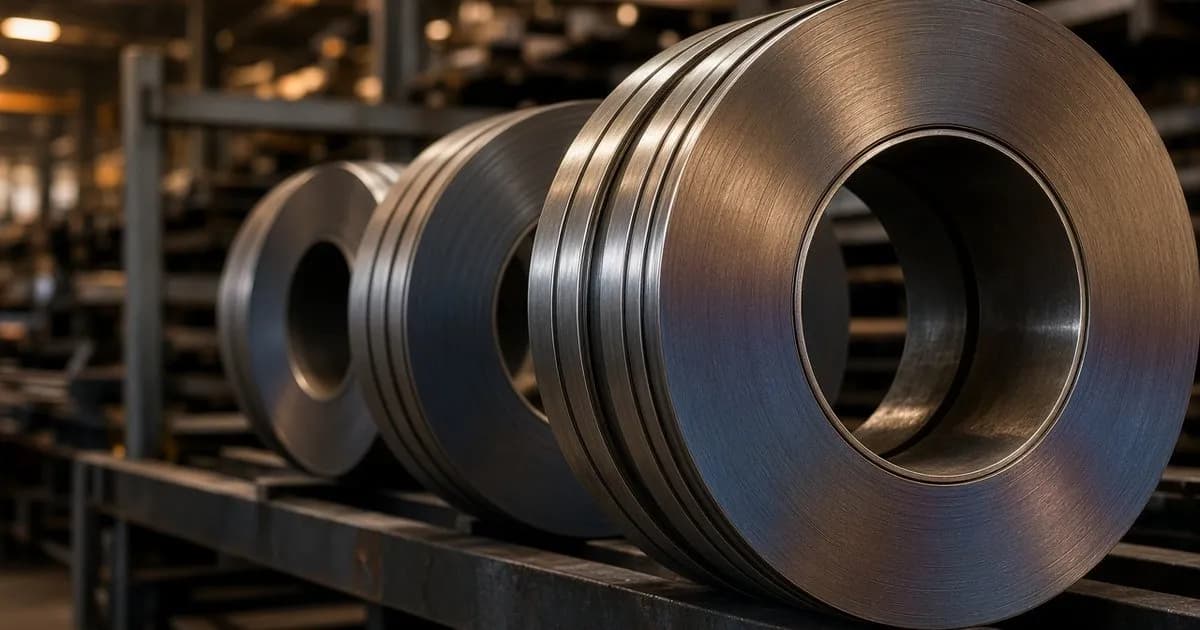
Hardened & tempered steel strips are precision spring strips that have already been through a controlled harden-and-temper heat treatment, so the coil arrives at a stated hardness instead of as soft, formable material. Buyers specify them when they want consistent mechanical properties out of the coil and do not intend to run a full post-forming heat treatment.
This article explains how that heat treatment works, what a hardness range such as 30–58 HRC actually means on an order, and how to write an RFQ that a mill can quote without a long clarification loop. It does not repeat the grade-by-grade applications already covered in BTC’s article on hardened and tempered steel strips grades and applications. For grade selection, use that article together with the hardened & tempered spring steel strips product page. BTC Precision Strips has manufactured steel strips in Kolkata since 1958. Confirm every value against the quotation and the mill test certificate.
How hardened & tempered steel strips are made
Hardening and tempering is a two-stage thermal process applied to cold-rolled carbon or low-alloy spring steel strips after they have been rolled to (or close to) finished thickness.
Hardening
The strip is heated into the austenitic range for the grade — that is, above the critical temperature — and then cooled rapidly (quenched). BTC’s product page describes this as producing the highest mechanical strength and hardness, but also a brittle condition that is not usable as-supplied for most components. In metallurgical terms, the quench is intended to transform the structure to martensite. If the section is too thick for the grade’s hardenability, the core may not fully harden, and a spring can take a permanent set in service. That is one reason the grade, thickness and hardness should be discussed together.
Tempering
The hardened strip is then reheated to a lower, controlled temperature and held for a controlled time. Tempering reduces excessive brittleness and moves hardness, toughness and spring properties into the band the customer has ordered. A higher tempering temperature generally lowers hardness and raises toughness; a lower tempering temperature leaves the strip harder. The useful purchase question is not “how hard can you go?” but “what hardness band does the part require, and can the mill hold it along the coil?”
Atmosphere, surface and consistency
BTC’s product description states that the process is conducted in an inert atmosphere to avoid oxidation, and that hardening lines use a protective atmosphere to help prevent surface decarburisation so hardness is consistent across coil length and width. Decarburisation (loss of carbon at the surface) matters on springs and blades because a soft skin can reduce fatigue life or edge performance even when a core hardness reading looks acceptable. If your part is fatigue-critical, say so on the RFQ and ask how surface and decarburisation will be checked and reported.
This process is the supply condition often abbreviated +QT (quenched and tempered) in European strip standards. Buyers who specify against EN 10132-4 typically state the delivery condition as +QT and then give a hardness or tensile band. BTC’s product page references EN 10132-4, DIN 17222, ASTM A684 and IS 2507. Name the standard and edition you want the order to be referenced against, and confirm on the quotation that the mill is supplying to that condition — do not rely on a page mention alone.
If you instead need to form the part first and heat-treat it in your own plant, you are not buying this product. You are buying annealed or special-temper high carbon steel strips (or a medium-carbon or low-alloy coil) and should say so clearly.
Hardness ranges explained
BTC’s hardened-and-tempered product page lists a hardness delivery range of 30 HRC minimum to 58 HRC maximum, pre-tempered to customer specification. That is a capability window, not a single hardness you should leave blank on the order. A 32 HRC clip spring and a 56 HRC blade blank are both “within range” and are not interchangeable.
What the number is trying to control
- Lower in the range generally means more toughness and more ability to flex without cracking, at the expense of peak hardness and wear resistance. Parts whose main job is to spring back, and which must not be brittle, often live in a mid or lower band agreed with the designer.
- Higher in the range generally means higher wear resistance and better edge retention, with less toughness. Cutting tools, saw blades and some knives are typically specified harder, provided the tooth or edge geometry can tolerate it.
- A tight band (for example a few HRC points, not the entire 30–58 window) is what a production part actually needs. Give a minimum and a maximum, not a single un-toleranced number, and say where hardness will be measured (surface, distance from the edge, and which scale).
The same product page also publishes narrower “hardness delivery” bands beside individual grades, together with tensile figures. Treat those bands as the mill’s published typical delivery windows for those grade lines, and still write the hardness you need on the RFQ. If your target sits outside a listed typical band but inside 30–58 HRC, ask whether it can be supplied, rather than assuming either yes or no.
HRC, HV / VPN and tensile strength
Rockwell C (HRC) is the scale BTC uses for this product’s overall range. Vickers (HV), also called VPN on some of BTC’s cold-rolled pages, is commonly used for thinner strip and for softer (annealed or special-temper) coil. Tensile strength (Rm) sometimes appears alongside hardness. These measures are related, but they are not the same test.
BTC’s hardness testing page summarises the three everyday methods: Brinell (a hardened ball and the diameter of the impression), Rockwell (depth of impression with a diamond cone on scales A and C, or a ball on scale B), and Vickers (a square-based diamond pyramid, with VPN defined as load divided by the pyramidal contact area). For conversion between scales, use BTC’s steel hardness conversion tool as a working aid, and state one official scale on the purchase order so you are not arguing about a converted number later.
Do not convert a 200 VPN anneal limit from a CRCA page into HRC and then treat it as a hardened-and-tempered specification. Those are different products.
Other details to specify besides hardness
Hardness is necessary, but it is not sufficient. The following items should be on the same RFQ.
Grade and standard
Name the grade as you know it (for example C-80, C75S, 50Cr4V2) and any standard you need referenced. If you only have a legacy name, ask the mill to map it and to restate the chemistry on the quote. Grade comparisons belong on the product page and the existing grades article; this order checklist only needs a clear choice.
Thickness, width and tolerance
BTC’s product page lists a thickness range of 0.05–4.00 mm and a width range of 6–550 mm, and it also lists thickness tolerances down to ±0.005 mm and slit-width tolerances down to ±0.02 mm. Those are published figures. Your drawing may need a wider or tighter band. Write the nominal size and the tolerance you actually require. If you also have a flatness, camber or coil-set limit, include it.
Surface finish
The product page lists bright polished, blue, brown and grey finishes. Colour on hardened-and-tempered strip is often a result of the tempering atmosphere and oxide film; do not treat a colour name as a hardness. If the part will be plated, polished, or used as a visible component, say so, because surface and residual oil or oxide affect later processing.
Edge condition
BTC lists one- or both-side rounded edges (also described as No. 1), square edges (No. 3), chamfered edges, and deburred sheared edges. Springs and fatigue-loaded parts often need a rounded or carefully deburred edge. Blades may need a particular slit or dressed edge before tooth cutting. “Any edge” is not a specification.
Form of supply
The product page states that material is supplied in precision-wound slit coils, with inner diameters of 300 mm, 400 mm or 500 mm and customised outer diameters maintained on specification, and that cut-to-length material can be supplied from 100 mm to 4000 mm. Give the ID/OD limits your line can accept, or the cut length and length tolerance, and the maximum coil weight if your handling equipment is limited. BTC’s steel coil weight calculator can help you estimate coil weight from diameters and width; it uses a steel density of 7,850 kg/m³, which you should treat as a working figure, not as a weighed certificate.
RFQ checklist for hardened & tempered steel strips
Copy this list into the message on BTC’s enquiry form, or attach it to an email, and fill in every line you can.
- Part or application — what the strip will become (for example retractor spring, flapper valve, band-saw blade), in one sentence.
- Grade — name, and the standard if known. If unknown, say so and give the required properties.
- Delivery condition — hardened and tempered (+QT), not annealed.
- Hardness range — minimum and maximum, in HRC (or HV if that is what the drawing uses), plus the measurement location if the drawing states one.
- Thickness — nominal and tolerance, in millimetres.
- Width — nominal and tolerance, in millimetres.
- Edge condition — rounded (one or both sides), square, chamfered or sheared, as required.
- Surface finish — bright polished, blue, brown, grey, or a drawing call-out.
- Coil or cut length — ID, OD and maximum coil weight, or cut length and length tolerance.
- Quantity — trial quantity and annual or batch quantity, if both are relevant.
- Documents — mill test certificate type (if you need batch-specific results, say EN 10204 Type 3.1 rather than only “MTC”), and any additional tests (decarburisation, tensile, flatness).
- Packing and destination — if this is an export shipment, say the destination country and any packing constraint. The product page describes rust-preventive oil, multi-layer VCI film and heat-treated wooden pallets for sea freight; confirm what you need on the order.
Then send the enquiry or call +91 85849 48988. A completed checklist is more useful than a request for “H&T strip, good quality, best price”.
Common specification mistakes
- Ordering “hardened and tempered” without a hardness band. The published window is 30–58 HRC. That is too wide for a production part.
- Mixing this product with annealed high-carbon coil. If you still have to form and then harden the part, order the CRCA product, not this one.
- Using a grade nickname without chemistry or a standard. C75, C80, CK75 and C75S are related names, not a single automatic chemistry.
- Ignoring edge and surface. Many fatigue failures start at a burr or a damaged surface, not in the middle of a hardness band.
- Omitting coil ID/OD or cut-length limits. A technically correct coil that will not go on your decoiler is still a failed delivery.
- Asking for “MTC” without a type. “MTC” is informal. If you need results from the delivered batch, specify the inspection document type.
Frequently asked questions
What is the difference between hardening and tempering?
Hardening (heating and quenching) raises hardness and strength but leaves the steel brittle. Tempering is a lower-temperature reheat that reduces that brittleness and sets the final hardness. Hardened & tempered steel strips have been through both steps before despatch.
What hardness can I order?
BTC lists 30–58 HRC as the overall delivery range, to customer specification. Order a band inside that window that matches the part, not the whole window. If you have only a tensile requirement, say so and ask the mill to propose an equivalent hardness band and to state it on the quote.
Can I form hardened & tempered steel strips?
Limited punching, slitting and shallow forming are common, but the material will not behave like annealed strip. If your process needs a tight bend, a deep form or a coiled spring made from soft stock, buy annealed or special-temper coil and heat-treat after forming. Describe the forming step on the RFQ if you are unsure.
Why does the mill ask for edge and surface as well as hardness?
Because hardness does not describe the slit edge or the surface film. Fatigue-loaded springs and cutting edges are sensitive to both. Specifying them reduces the chance of a technically “in hardness” coil that still fails in the press or in service.
What documents should I request?
Ask for a mill test certificate that reports the actual checks you care about — typically chemistry, hardness, and dimensions, plus surface or decarburisation if the part is critical. If you need those results to come from the delivered batch, specify an EN 10204 Type 3.1 inspection certificate rather than a generic “certificate”.
How is this different from the existing grades and applications article?
That article covers what hardened and tempered strip is used for and which grades BTC lists. This article covers how the material is made, how to read a hardness range, and how to write the order. Use both, then send a completed checklist through the enquiry form.
Next step
If the grade and hardness band are already on your drawing, open the hardened & tempered steel strips product page, copy the RFQ checklist into the enquiry, and send it through. If you are still choosing a grade, read the grades and applications article first, then come back to this checklist. BTC Precision Strips has been in this business since 1958; a complete specification is the fastest way to a usable quote.

BTC Admin
Metallurgy Specialist
Precision steel strip specialists and metallurgists at BTC Precision Strips, delivering precision cold rolled and hardened tempered steel solutions since 1958.