
Hardened & Tempered Steel Strips: Grades & Applications
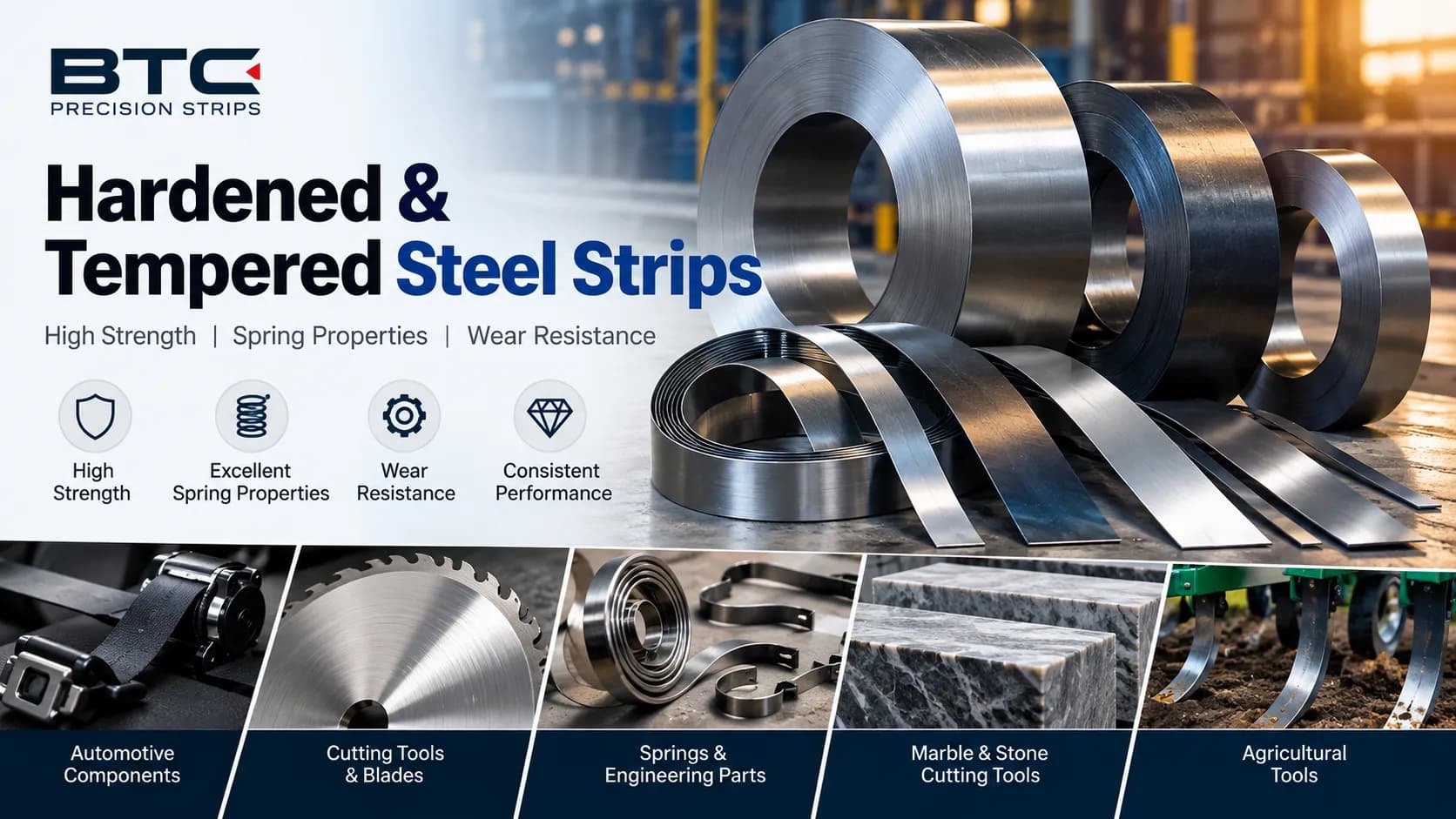
Hardened & Tempered Steel Strips: Applications, Grades and Buying Guide
When a manufacturing application needs a combination of hardness, strength, spring properties and dimensional consistency, ordinary cold-rolled steel may not be enough. This is where hardened and tempered steel strips are commonly used.
Hardened and tempered spring steel strips are specially heat-treated to achieve controlled mechanical properties while maintaining the toughness required for demanding industrial applications.
They are widely used in automotive components, cutting tools, saw blades, springs, engineering components, masonry tools and other precision applications.
What Are Hardened & Tempered Steel Strips?
Hardened and tempered steel strips are steel strips that undergo a controlled heat-treatment process.
During hardening, the steel is heated to a suitable temperature and rapidly cooled to increase its strength and hardness. However, hardened steel can become excessively brittle. Tempering is therefore carried out by reheating the steel to a lower controlled temperature.
The combination of hardening and tempering helps produce a better balance between:
- Hardness
- Strength
- Toughness
- Wear resistance
- Spring properties
- Workability
The exact properties depend on the steel grade, heat-treatment conditions and required hardness.
Why Are Hardened & Tempered Steel Strips Used?
Manufacturers choose H&T steel strips when the finished component needs predictable mechanical performance.
Some important advantages include:
1. Controlled Hardness
Different industrial applications require different hardness levels. Controlled heat treatment allows manufacturers to produce strips within the required hardness range.
BTC Precision Strips offers hardened and tempered steel strips with hardness ranging from 30 HRC to 58 HRC, depending on the grade and specification.
2. High Strength
Heat treatment improves the mechanical strength of the steel, making it suitable for components exposed to repeated loading, cutting forces or mechanical stress.
3. Spring Properties
Spring steel strips need to return to their original shape after deformation. Properly hardened and tempered material can provide the spring characteristics required for components such as seat-belt springs, clutch springs and other industrial springs.
4. Wear Resistance
Higher hardness can provide better resistance to wear, which is important for cutting tools, blades and other components exposed to friction or repeated contact.
5. Consistent Performance
For industrial production, consistency is important. Uniform hardness, thickness, surface condition and edge quality can help manufacturers maintain predictable production results.
Common Applications of Hardened & Tempered Steel Strips
H&T steel strips are used across several industries.
Automotive Applications
Automotive manufacturers use spring and hardened steel strips for components that require strength, flexibility and fatigue resistance.
Common applications include:
- Seat-belt springs
- Retractor springs
- Wiper blade steel
- Clutch components
- Flapper valves
- Circlips
- Chain guides
BTC Precision Strips specifically lists automotive and transport applications including seat-belt parts, wiper blades, clutch plates and flapper valves.
Cutting Tools and Blades
One of the major application areas for hardened steel strips is cutting equipment.
Applications include:
- Band saw blades
- Circular blades
- Gang saw blades
- Hand saw blades
- Band knives
- Doctor blades
These applications require a suitable combination of hardness, edge performance and toughness.
Woodworking and Carpentry Tools
Hardened and tempered steel can be used in tools designed for cutting or working with wood.
Examples include:
- Handsaws
- Circular saws
- Bandsaw blades
- Crosscut saws
- Plastering trowels
Marble and Stone Cutting
Steel strips are also used in tools and blades for stone and marble processing.
Typical applications include gang saw blades and circular saw blanks.
General Engineering
H&T strips can also be used for various engineered components, including:
- Clips
- Springs
- Die components
- Chain guides
- Filter bag rings
- Luggage handles
- Snap rings
- Masonry tools
- Agricultural tools
The appropriate grade and hardness should be selected according to the final application.
Common Grades of Hardened & Tempered Steel Strips
The correct grade is one of the most important factors when purchasing hardened and tempered steel strips.
BTC Precision Strips lists grades including:
| GradeApprox. Carbon Range | |
| C-55 | 0.50–0.60% |
| C-65 | 0.60–0.70% |
| C-80 / C-75 | 0.70–0.85% |
| C-98 / C100S | 0.90–1.05% |
| 50Cr4V2 | 0.45–0.55% |
| 75Ni8 | 0.75–0.85% |
The required grade should be selected based on the component's strength, hardness, spring characteristics, wear requirements and manufacturing process.
Available Sizes and Specifications
Hardened and tempered steel strips are generally purchased according to several technical parameters.
These include:
Thickness: 0.05–4.00 mm
Width: 6–550 mm
Hardness: 30–58 HRC
Surface finishes: Bright polished, blue, brown and grey
Edge conditions: One-side or both-side rounded, square, chamfered and sheared edges.
Special specifications may be required depending on the component being manufactured.
Coil or Cut-Length Supply
Hardened and tempered steel strips can be supplied in coil form for continuous manufacturing processes.
For applications requiring individual pieces, cut lengths may also be specified.
BTC Precision Strips states that special inside and outside coil diameter requirements can be accommodated, with cut-length supply available when required.
How to Choose the Right Hardened Steel Strip
Before placing an order, buyers should consider more than just thickness and width.
1. Steel Grade
Select a grade suitable for the required mechanical properties and end application.
2. Hardness
The required hardness depends on whether the material will be used for springs, blades, tools or other components.
3. Thickness and Width
Dimensional requirements should match the customer's production equipment and finished component.
4. Edge Condition
Edge requirements can be important for blades, stamped components and precision applications.
5. Surface Finish
The required surface condition should be specified according to the final application and manufacturing process.
6. Form of Supply
Decide whether the material is required in coils or cut lengths.
7. Technical Documentation
For industrial procurement, buyers may also require material specifications, test certificates and other quality documentation.
Hardened vs Tempered Steel: What's the Difference?
Hardened and tempered steel should not simply be treated as two separate products.
Hardening increases hardness and strength but can also make steel brittle. Tempering follows hardening to reduce excessive brittleness and achieve a more useful balance of hardness, toughness and mechanical performance.
This combination makes H&T steel strips suitable for applications where both strength and controlled flexibility are important.
Choosing a Hardened & Tempered Steel Strip Supplier
For industrial buyers, selecting the right supplier is just as important as selecting the right grade.
Before placing a bulk order, consider:
- Available steel grades
- Thickness and width capabilities
- Hardness range
- Surface finish options
- Edge conditions
- Coil dimensions
- Cut-length availability
- Quality-control processes
- Technical support
- Export and delivery capabilities
A supplier with experience in precision steel strips can help match the material specification to the final application.
Why Choose BTC Precision Strips?
BTC Precision Strips positions itself as a precision steel strip manufacturer with experience dating back to 1958. Its product range includes hardened and tempered spring steel strips alongside other precision steel strip products.
For H&T applications, BTC offers multiple grades, thicknesses, widths, hardness levels, surface finishes and edge conditions to support different industrial requirements.
The company also supplies material in coil form and can provide cut lengths for applications where required.
Frequently Asked Questions
What are hardened and tempered steel strips?
They are steel strips that have undergone controlled hardening and tempering heat treatment to achieve specific hardness, strength, toughness and spring properties.
What are hardened steel strips used for?
They are commonly used for cutting tools, saw blades, springs, automotive components, engineering parts, masonry tools and other applications requiring controlled mechanical properties.
What is the hardness range of H&T steel strips?
The available range depends on the grade and specification. BTC Precision Strips lists a hardness range of 30 HRC minimum to 58 HRC maximum.
What grades are available?
Common grades listed by BTC include C-55, C-65, C-75/C-80, C-98/C100S, 50Cr4V2 and 75Ni8.
Can hardened steel strips be supplied in coils?
Yes. H&T steel strips can be supplied in coil form, with special inside and outside diameter requirements available where required. Cut-length supply is also possible.
How do I select the right steel strip?
Start with the end application and define the required grade, thickness, width, hardness, surface finish and edge condition. For critical applications, it is advisable to discuss the technical requirements with the steel strip manufacturer before ordering.
Get the Right Steel Strip for Your Application
The right hardened and tempered steel strip can make a significant difference in the performance and reliability of a manufactured component.
Whether you are sourcing steel strips for automotive components, saw blades, industrial knives, springs, masonry tools or general engineering applications, the material should be selected according to the required grade, hardness, dimensions and processing conditions.
Contact BTC Precision Strips to discuss your application and request a specification-based quotation.