
Spring Steel Strips: Grades, Properties and Applications
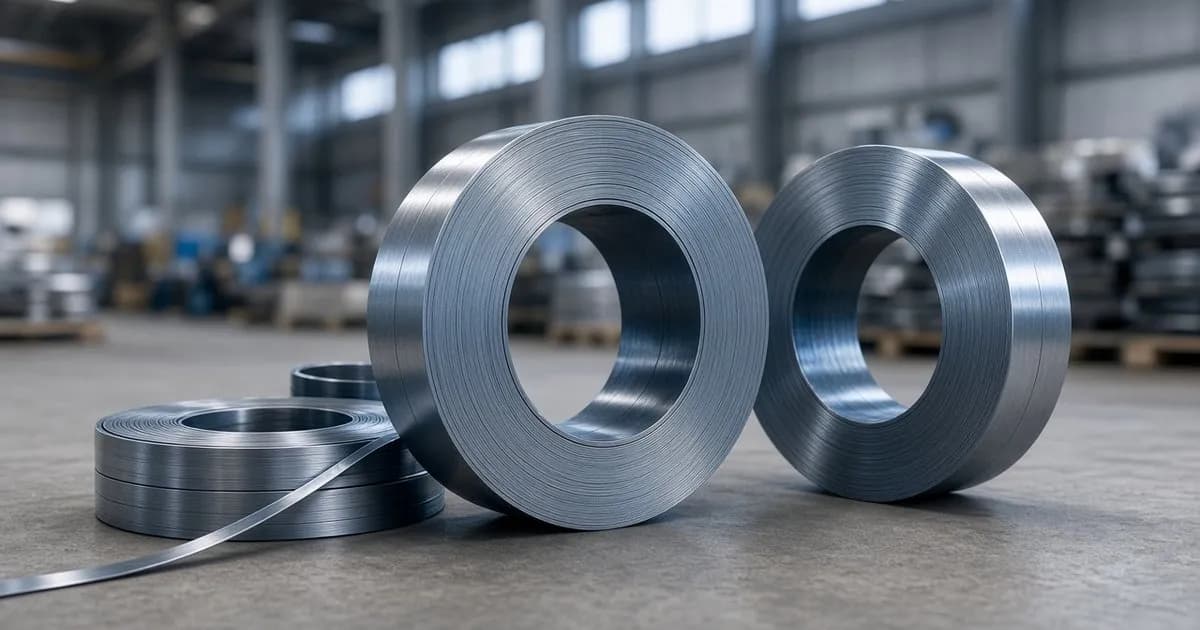
Spring steel strips are precision steel strips specified so a formed part can deflect under load and return to shape, rather than take a permanent set. The buying decision is which combination of grade, delivery condition, hardness, thickness, width and edge will survive the load cycle of the finished component.
Most orders use one of two supply conditions. The first is cold-rolled, annealed or specially tempered strip — including high carbon steel strips — that you form and then heat-treat. The second is already hardened & tempered steel strips, supplied at a stated hardness so parts can be stamped or used with little or no further heat treatment. BTC Precision Strips, a Kolkata manufacturer and exporter of precision steel strips since 1958, offers both routes. Confirm chemistry, hardness and size against the quotation and the mill test certificate; this guide is not a substitute for the product data on each page.
What are spring steel strips?
Spring steel strips are narrow, cold-rolled carbon or low-alloy steels whose composition and processing are chosen for a high elastic limit and useful fatigue life after heat treatment — or after they have already been hardened and tempered by the supplier. In everyday purchasing language, “spring steel strip” covers both the raw cold-rolled coil you will harden yourself and the pre-hardened coil you will stamp to finished hardness.
That usage appears on BTC’s own product pages. The CRCA high carbon steel strips page describes high carbon steels as commonly known as spring steel, used at high stresses and heat-treated for a high elastic limit and fatigue resistance without becoming so brittle that they fail suddenly in service. The companion product is named Hardened & Tempered Spring Steel Strips: the same family, already heat-treated to stated hardness.
Two cautions follow. Not every high-carbon strip is used as a spring, and not every spring is plain high-carbon steel. Alloy grades such as 50Cr4V2 / 50CrV4 and 75Ni8, listed on BTC’s hardened-and-tempered and low-alloyed pages, are used where hardenability, fatigue or toughness go beyond a plain carbon grade. “Spring steel” is a performance intent, not a single standard number: the order still has to name a grade or chemistry, a delivery condition, and the hardness or mechanical target.
The properties that matter in spring steel strips
A spring, a retractor, a flapper valve or a saw blade all ask the steel to store and release energy. The properties below are the ones that usually decide whether a coil is fit for that work.
Resistance to permanent set
If a spring takes a permanent set (sometimes called sagging), the component no longer delivers the design load. BTC’s high carbon steel strips page highlights hardenability in this context: only fully hardened springs have the maximum resistance to taking a permanent set. That is why a hardness or tensile target, and a requirement for through-hardening where section thickness demands it, belong on the enquiry — not only a grade name.
Fatigue resistance
Most spring and valve parts see cyclic load, not a single bend. Fatigue life depends on surface condition, decarburisation, edge quality, inclusions and thickness variation, as well as hardness. Specify the finish and edge you need, and ask for hardness, dimensions, surface and, where relevant, decarburisation to appear on the mill test certificate.
A usable balance of hardness and toughness
Higher hardness generally improves wear resistance and helps a blade hold an edge, but it also reduces toughness. Hardening alone makes carbon steel hard and brittle; tempering is used to pull hardness back to a useful range and restore toughness. The “right” hardness is the one that meets the component drawing, not the highest number a mill can print.
Dimensional consistency and edge quality
Thickness, width, flatness and camber affect both the formed geometry and the stress in the part. A burred or torn slit edge is a fatigue starter; a rounded or chamfered edge is often specified for springs and blades. BTC’s hardened-and-tempered page lists one- or both-side rounded, square, chamfered and sheared edges, and also refers to rounded (No. 1) and square sheared (No. 3) edges. Put the edge condition in the RFQ if the part is fatigue-critical or will be used as a cutting edge.
Annealed versus hardened & tempered steel strips
Choosing a delivery condition is as important as choosing a grade. The same nominal chemistry can be supplied soft for forming, work-hardened by rolling, or already hardened and tempered.
| Delivery conditionWhat you receiveTypical next step in your plantWhere BTC lists it | |||
| Fully annealed CRCA | Soft, formable cold-rolled strip. BTC’s high carbon page lists a maximum hardness of 200 VPN for fully annealed material. | Blank or form, then harden and temper to the finished hardness. | CRCA high carbon steel strips; also CRCA medium carbon steel strips |
| Special temper / rolling hard | Strip rolled to a target hardness, without a final anneal. BTC’s high carbon page lists a special-temper range of 230–270 VPN. Rolling-hard strip is described as being punched and formed and, if required, sent for heat treatment. | Limited forming; possible subsequent heat treatment. | High carbon special temper; rolling hard steel strips |
| Hardened and tempered (+QT) | Strip already heat-treated. BTC lists a hardness range of 30 HRC minimum to 58 HRC maximum, to customer specification, with bright polished, blue, brown or grey surfaces. | Slit, stamp or use at, or close to, the supplied hardness. Further heat treatment is usually unnecessary. | Hardened & tempered spring steel strips |
There is no universally better option. Annealed strip suits a forming step that hardened material will not survive, when you will heat-treat afterwards. Pre-hardened strip suits buyers who want consistent hardness out of the coil and can stamp or use the material in that condition. If you are unsure, describe the forming steps and finished hardness on the enquiry and ask the mill to propose a delivery condition.
Grades used for spring steel strips
Grade names vary by standard. The same coil might be called C-75 or C-80 in a mill list, C75S (1.1248) under the EN spring-strip system, or compared with SAE/AISI 1080 in a US enquiry. Treat names as a starting point and confirm chemistry and the governing standard on the order. BTC publishes a steel grade equivalents table, and an article on hardened and tempered steel strips grades and applications covers the heat-treated product in detail.
The table below summarises grades BTC currently lists on its product pages for spring and related strip, with the carbon ranges published on those pages. It is not a claim that the grades are interchangeable.
| Grade as listed by BTCCarbon range (from the product page)Where it is listedTypical use-case (from BTC application lists) | |||
| C-55 / C55S | 0.50–0.60% | Hardened & tempered; also CRCA medium carbon as C-55 | General springs and formed parts where a mid-carbon grade is specified |
| C-65 / C67S | 0.60–0.70% | Hardened & tempered; also CRCA medium carbon as C-65 | Springs and components needing a step up in carbon from C-55 |
| C-75 / C-80 / C75S | 0.70–0.85% (H&T page); C-80 on the high carbon page is listed as 0.75–0.85% | Hardened & tempered and CRCA high carbon | Widely used spring and blade strip in this carbon range |
| C-85 / C85S | 0.80–0.90% | Hardened & tempered product page | Higher-carbon spring and cutting applications, as specified |
| C-98 / C100S | 0.90–1.05% | Hardened & tempered and CRCA high carbon (C-98) | Wear-intensive and high-carbon spring or blade work |
| C125 / HC21 / 125CR1 | 1.10–1.30% | CRCA high carbon | Listed by BTC for demanding high-carbon uses such as certain blades and tools |
| 50Cr4V2 / 50CrV4 | 0.45–0.55% C, with chromium and vanadium (see the product page for the full chemistry) | Hardened & tempered and low alloyed steel strips | Alloy spring applications where the enquiry calls for a chromium-vanadium grade |
| 75Ni8 | About 0.72–0.85% C with nickel (ranges differ slightly between the H&T and grades pages; confirm on the quotation) | Hardened & tempered; also on the grades table | Nickel-bearing spring strip where that grade is specified |
International names are useful for comparison, not automatic substitutes. On BTC’s grades page, DIN C80W1 and SAE/AISI 1080 appear in the high-carbon group at 0.75–0.90% carbon; SAE/AISI 1095 is shown at 0.95–1.05%. SAE 1070, a standard carbon steel in SAE J403 with a heat analysis of 0.65–0.75% carbon, is often treated as comparable to EN C67S, but it is not listed as a BTC product grade on the pages reviewed here. Compare chemistry, and confirm any substitution in writing.
Medium-carbon grades such as C-40 (listed by BTC at 0.35–0.45% C) and the DIN C45 / SAE 1045 equivalents on the grades page (0.40–0.50% C) are used for formed parts that are later quenched and tempered, but they are not high-carbon spring steels. If the drawing says C45 or 1045, start from the medium-carbon product, not from a C-80 enquiry.
Applications of spring steel strips
The lists below are taken from BTC’s product pages. They describe typical demand; they are not a promise that one grade or hardness suits every item.
Automotive and transport
BTC lists seat-belt parts and retractor springs, wiper-blade steel, clutch components and flat springs, flapper valves (including shock-absorber and compressor work), circlips and chain guides. These parts usually need a high elastic limit, fatigue resistance and tight thickness control. Retractor springs are often bought already hardened and tempered; some formed clips start as annealed or special-temper coil.
Cutting tools and blades
Band-saw, circular, gang-saw, hand-saw and pit-saw blades, band knives, doctor blades, leather-splitting knives and various masonry or stone-cutting blanks appear on the hardened-and-tempered applications list. Blade work typically needs a hardness high enough to hold an edge, plus enough toughness to resist tooth or edge chipping, and an edge condition that matches the tooth-cutting or grinding process.
General engineering, hardware and textiles
Clips and springs, die components, filter-bag and snap rings, luggage handles, drop pins, textile parts, and agricultural or masonry tools appear across the hardened-and-tempered, high-carbon and medium-carbon pages. State formability, finished hardness and any coating or corrosion requirement up front.
If the part also needs corrosion resistance, specify BTC’s hardened and tempered stainless steel strips as a separate product family, not as a carbon spring grade.
How to choose spring steel strips for an industrial order
Work through these questions before you send an RFQ. They shorten the quotation cycle and reduce the risk of a coil that is chemically close but wrong in hardness or edge.
- What is the finished part, and how is it loaded? A retractor spring, a band-saw blade and a circlip share a material family but not a hardness or edge specification.
- Will you form the part in the soft condition and heat-treat it, or do you need strip that is already hardened and tempered? State the forming operations (blanking, bending, coiling, punching) and any heat-treatment capability you have.
- Which grade or standard is on the drawing? If you only have a legacy name (C75, CK75, 1075, 50CrV4), ask the mill to map it to the grade they will actually supply and to state the chemistry range.
- What hardness or tensile range is required in the finished part? Give the scale (HRC, HV/VPN or tensile) and a range, not a single unexplained number.
- What thickness, width, tolerance, surface and edge do you need? BTC’s hardened-and-tempered page lists thickness from 0.05–4.00 mm and width from 6–550 mm; the high carbon page lists 0.07–5.00 mm thickness and 8–500 mm width (with a note that, below 0.6 mm thickness, 4 mm width can be supplied). Treat those as published ranges, and state your exact size and tolerance on the order.
- Coil or cut length, and any inside or outside diameter limit? Both product pages state that material is supplied in coil form, that special ID and OD requirements can be maintained, and that cut lengths are available.
- What documents do you need? Name the mill test certificate type (for export orders, buyers often ask for an EN 10204 inspection certificate — specify 3.1 if you need results from the delivered batch) and any standard you want the strip referenced against.
When you are ready, send those details through BTC’s enquiry form or call +91 85849 48988. A clear RFQ is more useful than a one-line request for “spring steel strip, best quality”.
Frequently asked questions
Is spring steel the same as high carbon steel?
Not exactly. Many spring steel strips are high-carbon steels, and BTC’s high carbon page refers to those steels as commonly known as spring steel. Spring service can also use low-alloy grades such as 50Cr4V2 / 50CrV4 or 75Ni8, and some high-carbon strip is used for blades rather than springs. Specify the grade, delivery condition and properties, not only the words “spring steel”.
Should I buy annealed strip or already hardened & tempered steel strips?
Buy annealed or special-temper strip if you need significant forming and will heat-treat afterwards. Buy already hardened & tempered steel strips if you want the hardness delivered in the coil and can stamp or use the material in that condition. If forming is marginal, discuss it with the mill before ordering a full lot.
Which grade should I use for a flat spring or a saw blade?
There is no single correct grade. Flat springs are often specified in mid-to-high carbon or alloy grades at a hardness agreed with the designer. Saw blades typically need a higher hardness, a suitable edge, and sometimes a higher-carbon grade. Start from the drawing; if no grade is stated, share the application, thickness and target hardness rather than guessing a name.
Can spring steel strips be supplied in cut lengths as well as coils?
Yes. BTC’s relevant product pages state that material is supplied in coil form, that special inside and outside diameter requirements can be maintained, and that cut lengths can be supplied if the customer requires them. Put the length, length tolerance and any packing requirement on the RFQ.
How do I compare a C75 or C80 enquiry with SAE 1080 or an EN grade?
Use a grade-equivalents table, such as BTC’s grades page, then compare carbon, manganese and residual limits. SAE/AISI 1080 is shown there with DIN C80W1. Names can overlap without being identical, so the order should state the standard and chemistry, not only a familiar nickname.
What information does BTC need to quote spring steel strips?
At minimum: grade or chemistry, delivery condition, hardness or tensile range and the scale, thickness and width with tolerances, edge and surface, coil or cut length, quantity, and any test-certificate or packing requirement. The enquiry page asks for grade, thickness, width and quantity; add the rest in the message to avoid a follow-up loop.
Next step
If you already know the grade and delivery condition, go to hardened & tempered spring steel strips or CRCA high carbon steel strips and send the specification through the enquiry form. If you are still comparing options, include the finished application and the forming route. BTC Precision Strips has manufactured steel strips since 1958; a complete specification is the fastest way to a usable quote.
BTC Admin
Metallurgy Specialist
Precision steel strip specialists and metallurgists at BTC Precision Strips, delivering precision cold rolled and hardened tempered steel solutions since 1958.