
Importing High Carbon Steel Strips from India: A Buyer’s Guide
If you are looking for an exporter of high carbon steel strips in India, coil quality is only half of the job. The other half is a clear specification, the right inspection documents, packing that survives a sea passage, and an Incoterm that states who pays for freight, insurance and export clearance — and where risk transfers.
This guide is for purchasing and quality teams importing high carbon steel strips from India. It draws on DGFT’s export-document guidance, the Incoterms® 2020 rules of the International Chamber of Commerce (ICC), and packing details on BTC Precision Strips’ product pages. BTC, based in Kolkata, has manufactured precision steel strips since 1958. Nothing below is a freight quote, a customs ruling or a legal opinion; confirm documents and terms on the contract.
Specify the steel before you specify the shipment
An order that says only “high carbon spring steel, 1 mm × 50 mm, CIF” will generate questions, delays or the wrong coil. Agree the material first, then the logistics.
For annealed or special-temper coil, use BTC’s high carbon product page and state grade (for example C-80, C-98 or C125 / HC21 / 125CR1), delivery condition, hardness and scale (the page lists a fully annealed maximum of 200 VPN and a special-temper range of 230–270 VPN), size and tolerances, edge, surface, coil or cut length, and quantity. For already heat-treated material, use the hardened & tempered spring steel strips page and state hardness in HRC (BTC lists 30–58 HRC to customer specification). Settle that engineering choice before the commercial terms.
Also agree:
- The standard or chemistry, not only a nickname.
- The mill test certificate type (see below).
- Any additional tests (tensile, decarburisation, flatness, microstructure).
- Marking, coil ID/OD, maximum coil weight, and whether cut lengths are required.
- The destination, Incoterm and named place or port.
Send it through BTC’s enquiry form or call +91 85849 48988. BTC’s contact page lists the Kolkata head office at 21A, Canning Street, Kolkata 700001, email info@btstrips.com.
Documents from an exporter of high carbon steel strips
DGFT’s “How to Export” guidance lists these as the mandatory documents for import and export:
- Bill of lading or airway bill
- Commercial invoice cum packing list
- Shipping bill / bill of export (for exports) or bill of entry (for imports)
It also notes that other documents, such as a certificate of origin or an inspection certificate, may be required depending on the case. Your contract and the destination country’s import rules can add to that list; they rarely subtract from it.
Commercial invoice and packing list
The commercial invoice is the primary billing and valuation document. It should match the contract: parties, product description, grade and size, quantity, value and currency, Incoterm and named place, and the agreed customs tariff heading. DGFT notes that the invoice and packing list required by Customs may be issued as a combined “commercial invoice cum packing list”. Whether combined or separate, descriptions, weights and quantities must agree with the shipping bill and the transport document. Inconsistencies often delay clearance.
The packing list should identify each package: number of coils or bundles, net and gross weight, dimensions, and the grade and size in each package. For strip coils, include coil ID/OD if tagged, and the rust-prevention method if you have specified one.
Shipping bill and Let Export
The shipping bill is the Indian customs export declaration. DGFT states that it is filed electronically through ICEGATE, and that goods cannot be exported until it is filed. Customs then has to permit the export (often called a Let Export order) before loading. You will not file this yourself, but you should expect the exporter or their broker to file it, and you should make sure the invoice values and descriptions you approved are the ones declared.
Bill of lading or airway bill
For sea freight, the bill of lading is issued by the carrier or its agent. It is the contract of carriage and, in many forms, a document of title. For air freight, the airway bill is the contract of carriage and is not a document of title in the same way. The Incoterm, ports or airports, package count and weights should agree with the invoice and packing list. Under a letter of credit, mismatches with the required transport document are a frequent discrepancy.
Certificate of origin
A certificate of origin states the country in which the goods were manufactured. DGFT describes it as a document that may be required depending on the case; many buyers, destination customs authorities and letters of credit do require it. Preferential certificates, used to claim a free-trade duty concession, are a separate instrument and only help if the goods and the paperwork meet that agreement’s rules. Ask for a non-preferential certificate if you only need proof of Indian origin.
Other documents that often appear on steel-strip orders
- A mill test certificate or inspection certificate (see the next section).
- A cargo insurance certificate, if the Incoterm makes the seller responsible for insurance (CIF or CIP) or if you have asked the seller to arrange a policy anyway.
- Evidence that wooden packing meets the relevant phytosanitary standard, plus a packing declaration if the destination or letter of credit asks for one.
Do not invent a customs tariff heading if you are not sure. Agree it with the exporter and, if needed, your import broker, then use the same heading, description and quantity on every document.
Mill test certificates: ask for a type, not only “MTC”
“MTC” and “mill test report” are informal names and do not, by themselves, tell you whether the results come from the batch you are buying. For metallic products the usual reference is EN 10204, which defines four types of inspection document:
| EN 10204 typeWhat it isWhat the results relate to | ||
| 2.1 | Declaration of compliance with the order | No test results; the manufacturer states that the delivery complies with the order. |
| 2.2 | Test report | Test results from non-specific inspection — not necessarily from the product actually supplied. |
| 3.1 | Inspection certificate 3.1 | Results from specific inspection of the delivered lot or heat, validated by the manufacturer’s authorised inspection representative, independent of production. |
| 3.2 | Inspection certificate 3.2 | As 3.1, plus validation by the purchaser’s representative or an inspector designated by official regulations. |
If you need chemistry and hardness tied to the delivered coils, specify EN 10204 Type 3.1 on the purchase order and list the results to report (typically chemistry, hardness and dimensions; add tensile or decarburisation if the part requires them). A Type 2.2 report can suit less critical work, but it is not the same document. Type 3.2 adds third-party or purchaser witnessing; request it only when the contract or a regulation needs it, because it affects cost and lead time. Older manuals sometimes still say “3.1B”, which in the current standard corresponds to Type 3.1. Say so if you use the old name, and accept a current Type 3.1 or state the edition you require.
Packing high carbon steel strips for export
Precision strip rusts, and a coil edge is easily damaged, so packing should be written into the order, not left as “export standard”.
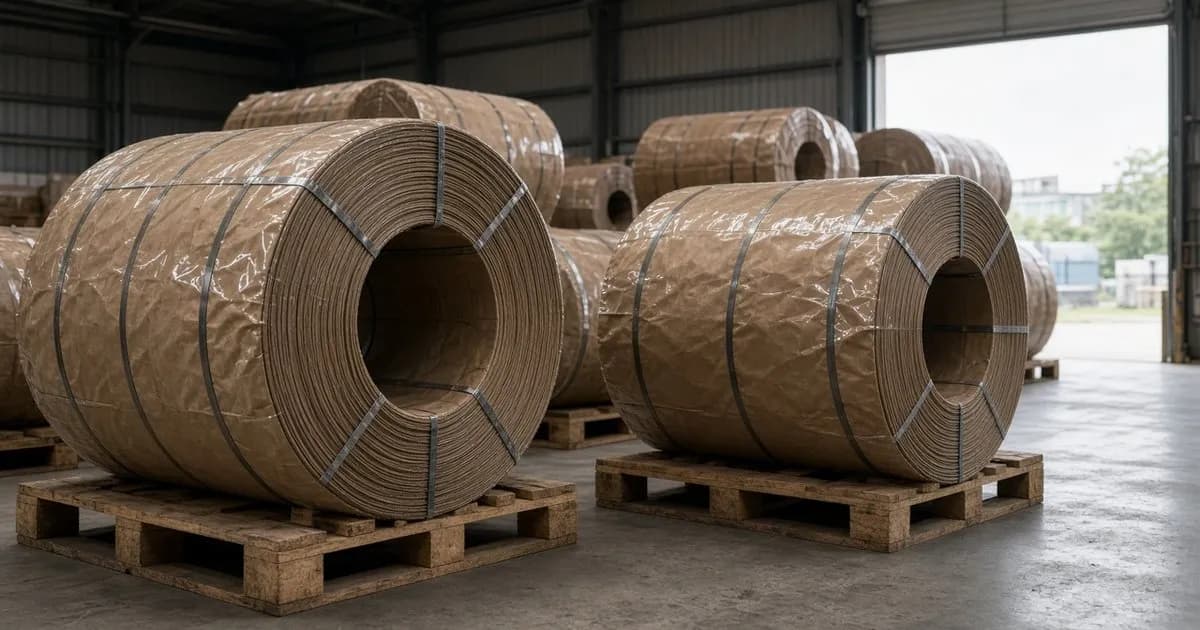
BTC’s hardened-and-tempered product page describes export packing as rust-preventive oil, multi-layer VCI anti-corrosion film, and strapping onto heat-treated wooden pallets for sea freight. Treat this as the published method and confirm or amend it on the quotation (for example if you cannot accept oil, or need a different pallet size). For annealed high-carbon coil, ask the exporter to state packing in the same way: oil or dry, VCI or other wrap, edge protection, strapping, and pallet or crate type.
Where wooden pallets or crates are used, many destination countries require the wood to be treated and marked to ISPM 15, the IPPC standard for wood packaging in international trade. BTC’s page refers to heat-treated wooden pallets; if ISPM 15 marking is required at destination, say so on the order. Do not assume a product-page reference automatically satisfies every border inspection.
Specify coil identification too: weatherproof tags showing grade, size, heat or coil number, net weight and the order reference, matching the mill test certificate and packing list. A coil that cannot be matched to its certificate is hard to release into controlled production.
Incoterms® 2020: agree the rule and the named place
Incoterms® 2020 are 11 official rules issued by the International Chamber of Commerce (ICC). They allocate tasks, costs and risks between seller and buyer. They do not, by themselves, transfer title, set the payment term, or replace a sales contract. The contract should cite the rule, the named place or port, and the edition, for example “FOB [named Indian port] Incoterms® 2020”.
Seven rules can be used for any mode or combination of modes: EXW, FCA, CPT, CIP, DAP, DPU and DDP. Four are for sea or inland waterway transport only: FAS, FOB, CFR and CIF. Steel-strip coils often move in containers, so be careful with FOB and CIF: those rules are built around delivery on board a vessel. Trade practice often points parties toward FCA, CPT or CIP when goods are handed to a carrier at a terminal. Choose the rule that matches the actual logistics, rather than copying a term from an old commodity contract.
| Rule (Incoterms® 2020)Delivery and risk, in briefWhat a strip buyer should watch | ||
| EXW (named place) | The seller places the goods at the buyer’s disposal at a named place, not loaded, and does not have to clear them for export. | The buyer takes on loading, Indian export clearance and all carriage. The ICC cautions buyers about EXW. Use it only if your forwarder can actually export from India on your behalf. |
| FCA (named place) | The seller delivers to the buyer’s nominated carrier at the named place and handles export clearance. | Often more practical than EXW or FOB for containerised cargo. Name the exact terminal or warehouse. |
| FOB (named port of shipment) | The seller delivers on board the buyer’s vessel at the named port. Risk transfers on board. Sea or inland waterway only. | The buyer arranges main carriage and insurance. Confirm that “on board” matches how the coils will actually be handed over. |
| CIF (named port of destination) | The seller delivers on board at origin and pays freight and insurance to the destination port, but risk transfers on board the vessel. Default cover is Institute Cargo Clauses (C), unless a higher cover is agreed. Sea or inland waterway only. | CIF does not keep the seller’s risk until your warehouse. Check whether Clause (C) cover is enough for finished strip. |
| CIP (named place of destination) | The seller delivers to its carrier, pays carriage and insurance to the named destination, and risk transfers on handover to that carrier. Incoterms® 2020 requires a higher cover under CIP, in line with Institute Cargo Clauses (A) or similar. | Usable for any mode, including multimodal container moves. Name the precise place, and check who unloads and who clears import customs. |
| DAP / DPU / DDP | The seller delivers at the named destination (DPU includes unloading; DDP includes import duty and clearance). | These place more obligation on the seller. Use them only if the exporter has agreed in writing to handle destination formalities and costs. |
A clear official overview is also published by the U.S. International Trade Administration in its “Know Your Incoterms” note. For the binding wording, use the ICC publication and your contract, not a blog summary (including this one).
A practical checklist for the import order
- Freeze the material specification (grade, condition, hardness and scale, size and tolerance, edge, surface, coil or cut length, quantity).
- Name the inspection document type (for example EN 10204 Type 3.1) and the tests to be reported.
- Agree packing, rust prevention, pallet treatment (including ISPM 15 if required), and coil marking.
- Agree the Incoterms® 2020 rule and the named place or port, plus who arranges main freight and insurance.
- Agree payment terms separately (an Incoterm is not a payment term).
- List the documents needed in the contract or letter of credit: invoice, packing list, bill of lading or airway bill, certificate of origin, insurance certificate if applicable, and the mill test certificate.
- Check that descriptions, quantities, weights, the tariff heading and the Incoterm will be identical on every document.
- On receipt, check coil tags against the certificate and packing list, and inspect wrap, rust and edge damage before the coils go into production.
For freight planning, BTC’s coil weight calculator uses a density of 7,850 kg/m³. Use a weighed figure for commercial settlement if the contract says so.
Frequently asked questions
What is the minimum set of documents I should expect from an Indian exporter?
DGFT lists the bill of lading or airway bill, the commercial invoice cum packing list, and the shipping bill as mandatory export documents. Buyers commonly also require a certificate of origin and a mill test certificate. Ask for them in the contract, and for Type 3.1 if you need batch-specific results.
Is “MTC” enough to write on the purchase order?
No. Say EN 10204 Type 3.1 (or 2.2 or 3.2) and list the results you need. “MTC” does not define the inspection type.
Which Incoterm should I use for containerised steel strips?
There is no single correct answer. EXW leaves export clearance to the buyer and should be used with care. FOB and CIF are sea-only rules built around delivery on board a vessel. For container moves, FCA, CPT or CIP are often a better fit. The right choice depends on who organises freight, insurance and risk. Name the place and the 2020 edition either way.
Does CIF mean the exporter is responsible until the coils reach my factory?
No. Under CIF Incoterms® 2020, risk transfers when the goods are on board the vessel at origin, even though the seller pays freight and minimum insurance to the destination port. If you want the seller to take the goods to your warehouse, that is a different rule (such as DAP) and must be agreed expressly.
How should coils be packed for a sea voyage?
The order should state rust prevention, wrapping, edge protection and the pallet or crate type. BTC’s hardened-and-tempered page describes rust-preventive oil, multi-layer VCI film and heat-treated wooden pallets. If the destination requires ISPM 15-marked wood, say so. Confirm packing for annealed high-carbon coils on the quotation.
How do I start an enquiry with BTC Precision Strips?
Use the enquiry form or the Kolkata office via the contact page (+91 85849 48988, info@btstrips.com). Include the specification, certificate type, packing, destination and Incoterm. Company background is on the about page.
Next step
If the grade and delivery condition are already decided, open the matching product page — high carbon steel strips or hardened-and-tempered spring strip — and send the specification, document list and destination through the enquiry form. BTC Precision Strips has been an Indian manufacturer and exporter of precision steel strips since 1958; a complete RFQ is the fastest way to a quotation you can use at the border and in production.

BTC Admin
Metallurgy Specialist
Precision steel strip specialists and metallurgists at BTC Precision Strips, delivering precision cold rolled and hardened tempered steel solutions since 1958.